How to Remove Magnet From Family Video Dvd

A CD-RW/DVD-ROM computer drive

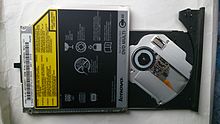
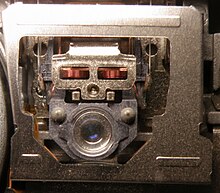
The CD/DVD drive lens on an Acer laptop

Lenses from a Blu-ray writer in a Sony Vaio E series laptop
In computing, an optical disc drive (ODD) is a disc drive that uses laser low-cal or electromagnetic waves within or near the visible light spectrum as part of the process of reading or writing data to or from optical discs. Some drives can only read from certain discs, but recent drives can both read and record, also called burners or writers (since they physically fire the organic dye on write-in one case CD-R, DVD-R and BD-R LTH discs). Compact discs, DVDs, and Blu-ray discs are common types of optical media which tin be read and recorded past such drives.
Drive types [edit]
Every bit of 2021[update], most of the optical disc drives on the market place are DVD-ROM drives and BD-ROM drives which read and record from those formats, forth with having backward compatibility with CD, CD-R and CD-ROM discs; compact disc drives are no longer manufactured exterior of sound devices. Read-only DVD and Blu-ray drives are also manufactured, simply are less commonly found in the consumer market and mainly express to media devices such as game consoles and disc media players. Over the last ten years, laptop computers no longer come up with optical disc drives in order to reduce costs and make devices lighter, requiring consumers to purchase external optical drives.
Appliances and functionality [edit]
Optical disc drives are an integral part of standalone appliances such as CD players, DVD players, Blu-ray Disc players, DVD recorders, sure desktop video game consoles, such every bit Sony PlayStation 4, Microsoft Xbox One, Nintendo Wii U, Sony PlayStation 5 and Xbox Serial X and as well in older consoles, such as the Sony PlayStation three and Xbox 360, and sure portable video game consoles, such every bit Sony PlayStation Portable (using proprietary now discontinued UMDs). They are likewise very commonly used in computers to read software and media distributed on disc and to record discs for archival and data exchange purposes. Floppy disk drives, with chapters of one.44 MB, accept been made obsolete: optical media are inexpensive and have vastly higher chapters to handle the large files used since the days of floppy discs, and the vast majority of computers and much consumer entertainment hardware accept optical writers. USB flash drives, high-capacity, modest, and inexpensive, are suitable where read/write adequacy is required.
Disc recording is restricted to storing files playable on consumer appliances (films, music, etc.), relatively small volumes of data (e.g. a standard DVD holds iv.7 gigabytes, however, higher-capacity formats such equally multi-layer Blu-ray Discs exist) for local employ, and data for distribution, only only on a small scale; mass-producing large numbers of identical discs past pressing (replication) is cheaper and faster than individual recording (duplication).
Optical discs are used to support relatively modest volumes of data, but bankroll up of entire difficult drives, which every bit of 2015[update] typically contain many hundreds of gigabytes or fifty-fifty multiple terabytes, is less practical. Big backups are often instead fabricated on external hard drives, as their price has dropped to a level making this feasible; in professional environments magnetic tape drives are also used.
Some optical drives also allow predictively scanning the surface of discs for errors and detecting poor recording quality.[1] [two]
With an option in the optical disc authoring software, optical disc writers are able to simulate the writing process on CD-R, CD-RW, DVD-R and DVD-RW, which allows for testing such as observing the writing speeds and patterns (e.g. constant angular velocity, constant linear velocity and P-CAV and Z-CLV variants) with different writing speed settings and testing the highest chapters of an individual disc that would be doable using overburning, without writing whatsoever information to the disc.[3]
Few optical drives allow simulating a FAT32 flash drive from optical discs containing ISO9660/Joliet and UDF file systems or audio tracks (fake as .wav files),[4] for compatibility with most USB multimedia appliances.[5]
Key components [edit]
Form factors [edit]
Optical drives for computers come in two main course factors: half-tiptop (also known every bit desktop drive) and slim type (used in laptop computers and meaty desktop computers). They exist equally both internal and external variants.
One-half-tiptop optical drives are around iv centimetres tall, while slim type optical drives are around 1 cm tall.
Half-height optical drives operate upwards of twice the speeds equally slim type optical drives, considering speeds on slim type optical drives are constrained to the physical limitations of the bulldoze motor'southward rotation speed (effectually 5000rpm[6]) rather than the performance of the optical pickup organization.
Considering half-height need much more than electrical ability and a voltage of 12 V DC, while slim optical drives run on 5 volts, external half elevation optical drives crave separate external power input, while external slim blazon are usually able to operate entirely on ability delivered through a reckoner'southward USB port. Half elevation drives are also faster than Slim drives due to this, since more ability is required to spin the disc at higher speeds.
Half-height optical drives hold discs in place from both sides while slim type optical drives spike the disc from the lesser.
One-half elevation drives fasten the disc using 2 spindles containing a magnet each, one nether and one above the disc tray. The spindles may be lined with flocking or a texturized silicone material to exert friction on the disc, to proceed it from slipping. The upper spindle is left slightly loose and is attracted to the lower spindle because of the magnets they accept. When the tray is opened, a mechanism driven by the movement of the tray pulls the lower spindle abroad from the upper spindle and vice versa when the tray is closed. When the tray is closed, the lower spindle touches the inner circumference of the disc, and slightly raises the disc from the tray to the upper spindle, which is attracted to the magnet on the lower disc, clamping the disc in identify. Simply the lower spindle is motorized. Trays in half tiptop drives often fully open and close using a motorized mechanism that can be pushed to close, controlled past the computer, or controlled using a push button on the drive. Trays on half height and slim drives can as well be locked by any program is using it, however it can even so exist ejected by inserting the end of a paper clip into an emergency squirt hole on the front of the drive. Early CD players such as the Sony CDP-101 used a separate motorized machinery to clench the disc to the motorized spindle.
Slim drives use a special spindle with spring loaded specially shaped studs that radiate outwards, pressing against the inner border of the disc. The user has to put uniform force per unit area onto the inner circumference of the disc to clamp it to the spindle and pull from the outer circumference while placing the pollex on the spindle to remove the disc, flexing information technology slightly in the procedure and returning to its normal shape after removal. The outer rim of the spindle may accept a texturized silicone surface to exert friction keeping the disc from slipping. In slim drives nigh if not all components are on the disc tray, which pops out using a spring machinery that can be controlled past the computer. These trays cannot close on their ain; they have to exist pushed until the tray reaches a end. [7]
Laser and optics [edit]
Optical pickup system [edit]

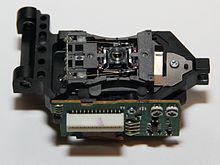


The most important function of an optical disc bulldoze is an optical path, which is inside a pickup caput (PUH). The PUH is too known as a laser pickup, optical pickup, pickup, pickup assembly, light amplification by stimulated emission of radiation associates, light amplification by stimulated emission of radiation optical assembly, optical pickup head/unit of measurement or optical assembly.[8] It usually consists of a semiconductor laser diode, a lens for focusing the laser beam, and photodiodes for detecting the light reflected from the disc'southward surface.[nine]
Initially, CD-type lasers with a wavelength of 780 nm (inside the infrared) were used. For DVDs, the wavelength was reduced to 650 nm (ruby-red color), and for Blu-ray Disc this was reduced even further to 405 nm (violet color).
Ii main servomechanisms are used, the offset to maintain the proper altitude between lens and disc, to ensure the laser beam is focused as a small-scale laser spot on the disc. The second servo moves the pickup head along the disc's radius, keeping the beam on the rails, a continuous spiral data path. Optical disc media are 'read' beginning at the inner radius to the outer edge.
Near the light amplification by stimulated emission of radiation lens, optical drives are unremarkably equipped with one to three tiny potentiometers (unremarkably carve up ones for CDs, DVDs, and usually a 3rd ane for Blu-ray Discs if supported by the bulldoze[ten]) that can be turned using a fine screwdriver. The potentiometer is in a series circuit with the light amplification by stimulated emission of radiation lens and tin can be used to manually increment and subtract the laser ability for repair purposes.[11] [12] [13] [14] [15] [16]
The laser diode used in DVD writers can have powers of up to 100 milliwatts, such high powers are used during writing.[17] Some CD players accept automatic gain control (AGC) to vary the power of the laser to ensure reliable playback of CD-RW discs.[18] [19]
Readability (the ability to read physically damaged or soiled discs) may vary among optical drives due to differences in optical pickup systems, firmwares, and damage patterns.[twenty]
Read-only media [edit]

The optical sensor out of a CD/DVD drive. The two larger rectangles are the photodiodes for pits, the inner 1 for country. This i also includes amplification and pocket-sized processing.
On mill-pressed read only media (ROM), during the manufacturing process the tracks are formed past pressing a thermoplastic resin into a nickel stamper that was fabricated by plating a glass 'chief' with raised 'bumps' on a flat surface, thus creating pits and lands in the plastic deejay. Because the depth of the pits is approximately ane-quarter to 1-6th of the laser's wavelength, the reflected axle's phase is shifted in relation to the incoming beam, causing mutual destructive interference and reducing the reflected axle's intensity. This is detected by photodiodes that create corresponding electrical signals.
Recordable media [edit]
| | This section is missing information near laser wattages for reading and writing of private media types. (August 2020) |

An optical disk recorder encodes (also known as called-for, since the dye layer is permanently burned) data onto a recordable CD-R, DVD-R, DVD+R, or BD-R disc (chosen a blank) by selectively heating (burning) parts of an organic dye layer with a laser.[ commendation needed ]
This changes the reflectivity of the dye, thereby creating marks that tin be read similar the pits and lands on pressed discs. For recordable discs, the process is permanent and the media tin be written to only in one case. While the reading laser is usually not stronger than 5 mW, the writing laser is considerably more powerful.[21] DVD lasers operate at voltages of around 2.5 volts.[22]
The higher the writing speed, the less time a laser has to rut a point on the media, thus its power has to increase proportionally. DVD burners' lasers often peak at near 200 mW, either in continuous moving ridge and pulses, although some have been driven upwards to 400 mW before the diode fails.
Rewriteable media [edit]
For rewritable CD-RW, DVD-RW, DVD+RW, DVD-RAM, or BD-RE media, the laser is used to melt a crystalline metal alloy in the recording layer of the disc. Depending on the amount of power applied, the substance may be allowed to melt back (change the phase back) into crystalline form or left in an baggy course, enabling marks of varying reflectivity to be created.
Double-sided media [edit]
Double-sided media may be used, but they are not easily accessed with a standard drive, as they must be physically turned over to access the information on the other side.
Dual layer media [edit]
Double layer or dual layer (DL) media have two independent data layers separated by a semi-reflective layer. Both layers are accessible from the aforementioned side, merely crave the optics to change the light amplification by stimulated emission of radiation's focus. Traditional single layer (SL) writable media are produced with a screw groove molded in the protective polycarbonate layer (not in the data recording layer), to pb and synchronize the speed of recording head. Double-layered writable media have: a kickoff polycarbonate layer with a (shallow) groove, a first data layer, a semi-reflective layer, a second (spacer) polycarbonate layer with another (deep) groove, and a 2d data layer. The first groove spiral usually starts on the inner edge and extends outwards, while the 2nd groove start on the outer edge and extends inwards.[23] [24]
Photothermal printing [edit]
Some drives back up Hewlett-Packard's LightScribe, or the alternative LabelFlash photothermal printing technology for labeling peculiarly coated discs.
Multi beam drives [edit]
Zen Technology and Sony have developed drives that use several light amplification by stimulated emission of radiation beams simultaneously to read discs and write to them at higher speeds than what would be possible with a single light amplification by stimulated emission of radiation axle. The limitation with a single laser beam comes from wobbling of the disc that may occur at loftier rotational speeds; at 25,000 RPMs CDs become unreadable[18] while Blu-rays cannot exist written to across v,000 RPMs.[25] With a unmarried light amplification by stimulated emission of radiation beam, the just manner to increase read and write speeds without reducing the pit length of the disc (which would allow for more pits and thus bits of data per revolution, but may require smaller wavelength light) is by increasing the rotational speed of the disc which reads more pits in less time, increasing data charge per unit; hence why faster drives spin the disc at higher speeds. In add-on, CDs at 27,500 RPMs (such as to read the inside of a CD at 52x) may explode causing all-encompassing damage to the disc'due south environment, and poor quality or damaged discs may explode at lower speeds.[26] [18]
In Zen'south system (developed in conjunction with Sanyo and licensed by Kenwood), a diffraction grating is used to split a laser beam into 7 beams, which are and so focused into the disc; a central axle is used for focusing and tracking the groove of the disc leaving half-dozen remaining beams (three on either side) that are spaced evenly to read 6 separate portions of the groove of the disc in parallel, effectively increasing read speeds at lower RPMs, reducing drive noise and stress on the disc. The beams so reflect back from the disc, and are collimated and projected into a special photodiode assortment to be read. The outset drives using the technology could read at 40x, later increasing to 52x and finally 72x. It uses a single optical pickup.[27] [28] [29] [xxx] [31] [32]
In Sony's system (used on their proprietary Optical Disc Archive organization which is based on Archival Disc, itself based on Blu-ray) the drive has 4 optical pickups, two on each side of the disc, with each pickup having ii lenses for a total of 8 lenses and light amplification by stimulated emission of radiation beams. This allows for both sides of the disc to be read and written to at the same time, and for the contents of the disc to be verified during writing.[33]
Rotational machinery [edit]
-

Comparison of several forms of disk storage showing tracks (not-to-scale); light-green denotes get-go and red denotes end.
* Some CD-R(W) and DVD-R(Westward)/DVD+R(W) recorders operate in ZCLV, CAA or CAV modes.
The rotational mechanism in an optical bulldoze differs considerably from that of a hard disk's, in that the latter keeps a constant angular velocity (CAV), in other words a constant number of revolutions per minute (RPM). With CAV, a higher throughput is generally achievable at the outer disc compared to the inner.
On the other paw, optical drives were developed with an assumption of achieving a constant throughput, in CD drives initially equal to 150 KiB/s. Information technology was a feature important for streaming audio data that always tend to require a constant bit rate. Just to ensure no disc capacity was wasted, a caput had to transfer data at a maximum linear rate at all times too, without slowing on the outer rim of the disc. This led to optical drives—until recently—operating with a abiding linear velocity (CLV). The spiral groove of the disc passed nether its head at a constant speed. The implication of CLV, equally opposed to CAV, is that disc angular velocity is no longer constant, and the spindle motor needed to be designed to vary its speed from between 200 RPM on the outer rim and 500 RPM on the inner, keeping the data rate constant.
Later CD drives kept the CLV epitome, only evolved to accomplish higher rotational speeds, popularly described in multiples of a base speed. Every bit a result, a 4× CLV drive, for instance, would rotate at 800-2000 RPM, while transferring data steadily at 600 KiB/s, which is equal to 4 × 150 KiB/s.
For DVDs, base or 1× speed is i.385 MB/southward, equal to 1.32 MiB/s, approximately nine times faster than the CD base of operations speed. For Blu-ray drives, base of operations speed is 6.74 MB/s, equal to 6.43 MiB/s.

The Z-CLV recording pattern is easily visible after burning a DVD-R.
Because keeping a constant transfer charge per unit for the whole disc is non and then important in nearly contemporary CD uses, a pure CLV approach had to be abandoned to keep the rotational speed of the disc safely low while maximizing information rate. Some drives work in a fractional CLV (PCLV) scheme, by switching from CLV to CAV only when a rotational limit is reached. Merely switching to CAV requires considerable changes in hardware design, so instead most drives use the zoned constant linear velocity (Z-CLV) scheme. This divides the disc into several zones, each having its ain constant linear velocity. A Z-CLV recorder rated at "52×", for example, would write at 20× on the innermost zone and and then progressively increase the speed in several discrete steps up to 52× at the outer rim. Without higher rotational speeds, increased read performance may be attainable by simultaneously reading more than one point of a data groove, also known as multi-beam,[34] but drives with such mechanisms are more expensive, less compatible, and very uncommon.
Limit [edit]
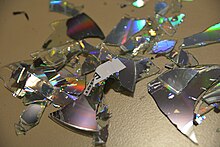
Both DVDs and CDs have been known to explode[35] when damaged or spun at excessive speeds. This imposes a constraint on the maximum prophylactic speeds (56× CAV for CDs or around 18×CAV in the case of DVDs) at which drives can operate.
The reading speeds of near half-height optical disc drives released since circa 2007 are limited to ×48 for CDs, ×16 for DVDs and ×12 (angular velocities) for Blu-ray Discs.[a] Writing speeds on selected write-in one case media are higher.[seven] [36] [37]
Some optical drives additionally throttle the reading speed based on the contents of optical discs, such as max. 40× CAV (constant angular velocity) for the Digital Sound Extraction ("DAE") of Sound CD tracks,[36] xvi× CAV for Video CD contents[37] and fifty-fifty lower limitations on before models such as 4× CLV (constant linear velocity) for Video CDs.[38] [39]
Loading mechanisms [edit]
Tray and slot loading [edit]
Current optical drives apply either a tray-loading mechanism, where the disc is loaded onto a motorized (as utilized by one-half-height, "desktop" drives) tray, a manually operated tray (as utilized in laptop computers, too chosen slim type), or a slot-loading mechanism, where the disc is slid into a slot and drawn in past motorized rollers. Slot-loading optical drives be in both half-superlative (desktop) and slim type (laptop) form factors.[7]
With both types of mechanisms, if a CD or DVD is left in the bulldoze after the estimator is turned off, the disc cannot be ejected using the normal eject mechanism of the drive. However, tray-loading drives account for this situation past providing a small hole where one can insert a paperclip to manually open up the drive tray to retrieve the disc.[40]
Slot-loading optical disc drives are prominently used in game consoles and vehicle sound units. Although assuasive more convenient insertion, those take the disadvantages that they cannot usually accept the smaller 80 mm diameter discs (unless 80 mm optical disc adapter is used) or any non-standard sizes, usually have no emergency eject pigsty or squirt button, and therefore have to be disassembled if the optical disc cannot be ejected normally. Withal, some slot-loading optical drives have been engineered to back up miniature discs. The Nintendo Wii, because of astern compatibility with Nintendo GameCube games,[41] [42] and PlayStation 3[43] video game consoles are able to load both standard size DVDs and fourscore mm discs in the same slot-loading drive. Its successor's slot bulldoze however, the Wii U, lacks miniature disc compatibility.[44]
At that place were as well some early CD-ROM drives for desktop PCs in which its tray-loading machinery will eject slightly and user has to pull out the tray manually to load a CD[ commendation needed ], like to the tray ejecting method used in internal optical disc drives of modern laptops and modern external slim portable optical disc drives. Like the acme-loading machinery, they have jump-loaded brawl bearings on the spindle.
Top-load [edit]
A small number of bulldoze models, mostly compact portable units, have a top-loading machinery where the drive chapeau is manually opened upwardly and the disc is placed straight onto the spindle[45] [46] (for example, all PlayStation Ane consoles, PlayStation 2 Slim, PlayStation 3 Super Slim, Nintendo GameCube consoles, nigh portable CD players, and some standalone CD recorders feature superlative-loading drives). These sometimes have the advantage of using jump-loaded ball bearings to concur the disc in identify, minimizing damage to the disc if the drive is moved while it is spun up.
Dissimilar tray and slot loading mechanisms by default, summit-load optical drives can be opened without being connected to power.
Cartridge load [edit]
Some early CD-ROM drives used a mechanism where CDs had to be inserted into special cartridges or caddies, somewhat similar in advent to a 3.5 inch micro floppy diskette. This was intended to protect the disc from accidental damage by enclosing information technology in a tougher plastic casing, merely did non proceeds broad acceptance due to the additional cost and compatibility concerns—such drives would also inconveniently require "bare" discs to be manually inserted into an openable caddy before use. Ultra Density Optical (UDO), Magneto-optical drives, Universal Media Disc (UMD), DataPlay, Professional Disc, MiniDisc, Optical Disc Archive also as early DVD-RAM and Blu-ray discs utilise optical disc cartridges.
Computer interfaces [edit]
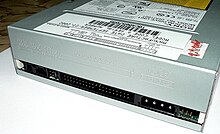
All optical disc-drives utilise the SCSI-protocol on a command motorcoach level, and initial systems used either a fully featured SCSI bus or every bit these were some what cost-prohibitive to sell to consumer applications, a proprietary cost-reduced version of the bus. This is considering conventional ATA-standards at the time did not back up, or take any provisions for any sort of removable media or hot-plugging of deejay drives. Most modern internal drives for personal computers, servers, and workstations are designed to fit in a standard five+ 1⁄four -inch (besides written as v.25 inch) bulldoze bay and connect to their host via an ATA or SATA charabanc interface, simply communicate using the SCSI protocol commands on software level as per the ATA Package Interface standard developed for making Parallel ATA/IDE interfaces compatible with removable media. Some devices may back up vendor-specific commands such as recording density ("GigaRec"), laser ability setting ("VariRec"), ability to manually hard-limit rotation speed in a way that overrides the universal speed setting (separately for reading and writing), and adjusting the lens and tray movement speeds where a lower setting reduces racket, as implmenented on some Plextor drives, as well as the power to force overspeed burning, meaning beyond speed recommended for the media type, for testing purposes, every bit implemented on some Lite-ON drives.[47] [48] [49] [fifty] Additionally, there may be digital and analog outputs for sound. The outputs may be connected via a header cable to the sound card or the motherboard or to headphones or an external speaker with a 3.5mm AUX plug cable that many early optical drives are equipped with.[51] [52] At one time, computer software resembling CD players controlled playback of the CD.[53] [54] Today the information is extracted from the disc equally digital data, to be played dorsum or converted to other file formats.
Some early optical drives accept dedicated buttons for CD playback controls on their front console, allowing them to act equally a standalone compact disc player.[51]
External drives were popular in the beginning, because the drives ofttimes required complex electronics to constitute, rivaling in complexity the Host figurer system itself. External drives using SCSI, Parallel port, USB and FireWire interfaces be, well-nigh modern drives being USB. Some portable versions for laptops power themselves from batteries or directly from their interface omnibus.
Drives with a SCSI interface were originally the only organization interface bachelor, but they never became popular in the toll sensitive depression-end consumer market which constituted majority of the demand. They were less common and tended to be more expensive, considering of the cost of their interface chipsets, more than complex SCSI connectors, and small volume of sales in comparison to proprietary price-reduced applications, merely virtually importantly because most consumer marketplace estimator systems did not have any sort of SCSI interface in them the market for them was small. However, support for multitude of various cost-reduced proprietary optical bulldoze charabanc standards were ordinarily embedded with sound cards which were often bundled with the optical drives themselves in the early years. Some sound card and optical drive bundles even featured a full SCSI passenger vehicle. Modernistic IDE/ATAPI compliant Parallel ATA and Serial ATA drive command chipsets and their interface engineering science is more than complex to manufacture than a traditional 8bit 50Mhz SCSI drive interface, because they feature properties of both the SCSI and ATA bus, but are cheaper to make overall due to economies of scale.
When the optical disc drive was commencement developed, it was non easy to add to calculator systems. Some computers such every bit the IBM PS/ii were standardizing on the three+ i⁄2 -inch floppy and three+ 1⁄2 -inch hard disk and did non include a place for a large internal device. Also IBM PCs and clones at starting time only included a single (parallel) ATA bulldoze interface, which by the fourth dimension the CD-ROM was introduced, was already being used to back up two hard drives and were completely incapable of supporting removable media, a drive falling off or being removed from the omnibus while the arrangement was alive, would cause an unrecoverable error and crash the entire system. Early consumer grade laptops only had no built-in high-speed interface for supporting an external storage device. High-end workstation systems and laptops featured a SCSI interface which had a standard for externally connected devices.

HP C4381A CD-Writer Plus 7200 Series, showing parallel ports to connect between a printer and the reckoner
This was solved through several techniques:
- Early sound cards could include a CD-ROM drive interface. Initially, such interfaces were proprietary to each CD-ROM manufacturer. A sound card could often have two or three different interfaces which are able to communicate with the CD-ROM drive.
- A method for using the parallel port to use with external drives was developed at some indicate. This interface was traditionally used to connect a printer, just despite popular myth it is non its only use and various different external auxiliary devices be for the IEEE-1278 motorcoach, including but not limited to tape fill-in drives etc. This was wearisome but an selection for low-to-midrange laptops with out integrated or PCMCIA extension bus connected SCSI.
- A PCMCIA optical bulldoze interface was as well adult for laptops.
- A SCSI carte du jour could be installed in desktop PCs to cater for an external SCSI bulldoze enclosure or to run internally mounted SCSI Hd drives and optical drives, though SCSI was typically somewhat more than expensive than other options, with some OEMs charging a premium for it.
Due to lack of asynchrony in existing implementations, an optical drive encountering damaged sectors may cause calculator programs trying to access the drives, such as Windows Explorer, to lock up.
Internal mechanism of a bulldoze [edit]
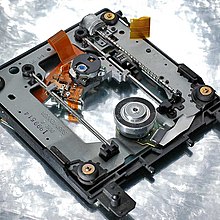
Internal machinery of a DVD-ROM Bulldoze. Come across text for details.
The optical drives in the photos are shown correct side upwards; the disc would sit on top of them. The laser and optical arrangement scans the underside of the disc.
With reference to the tiptop photograph, just to the correct of epitome center is the disc motor, a metal cylinder, with a gray centering hub and black rubber drive ring on top. There is a disc-shaped circular clench, loosely held inside the embrace and free to rotate; it'due south non in the photograph. Subsequently the disc tray stops moving inward, as the motor and its attached parts rise, a magnet near the top of the rotating associates contacts and strongly attracts the clamp to hold and center the disc. This motor is an "outrunner"-style brushless DC motor which has an external rotor – every visible part of information technology spins.
2 parallel guide rods that run between upper left and lower right in the photo carry the "sled", the moving optical read-write head. Every bit shown, this "sled" is close to, or at the position where it reads or writes at the border of the disc. To move the "sled" during continuous read or write operations, a stepper motor rotates a leadscrew to motility the "sled" throughout its total travel range. The motor, itself, is the short gray cylinder just to the left of the virtually-distant shock mountain; its shaft is parallel to the support rods. The leadscrew is the rod with evenly-spaced darker details; these are the helical grooves that engage a pin on the "sled".
In dissimilarity, the mechanism shown in the second photograph, which comes from a cheaply fabricated DVD role player, uses less authentic and less efficient brushed DC motors to both movement the sled and spin the disc. Some older drives use a DC motor to move the sled, merely also have a magnetic rotary encoder to proceed runway of the position. Most drives in computers apply stepper motors.
The grey metal chassis is stupor-mounted at its four corners to reduce sensitivity to external shocks, and to reduce drive noise from residual imbalance when running fast. The soft shock mount grommets are just below the brass-colored screws at the four corners (the left one is obscured).
In the 3rd photograph, the components under the cover of the lens mechanism are visible. The two permanent magnets on either side of the lens holder as well as the coils that move the lens can be seen. This allows the lens to be moved upwards, downward, forwards, and backwards to stabilize the focus of the beam.
In the fourth photo, the inside of the optics package tin be seen. Annotation that since this is a CD-ROM drive, there is just one laser, which is the black component mounted to the bottom left of the assembly. Just in a higher place the laser are the first focusing lens and prism that directly the beam at the disc. The tall, thin object in the center is a half-silvered mirror that splits the light amplification by stimulated emission of radiation axle in multiple directions. To the bottom right of the mirror is the main photodiode that senses the beam reflected off the disc. To a higher place the chief photodiode is a 2d photodiode that is used to sense and regulate the power of the light amplification by stimulated emission of radiation.
The irregular orange material is flexible etched copper foil supported by sparse sheet plastic; these are "flexible circuits" that connect everything to the electronics (which is non shown).
History [edit]
The first light amplification by stimulated emission of radiation disc, demonstrated in 1972, was the Laservision 12-inch video disc. The video signal was stored as an analog format like a video cassette. The first digitally recorded optical disc was a 5-inch audio compact disc (CD) in a read-only format created by Sony and Philips in 1975.[55]
The first erasable optical disc drives were announced in 1983, past Matsushita (Panasonic),[56] Sony, and Kokusai Denshin Denwa (KDDI).[57] Sony somewhen released the first commercial erasable and rewritable 5+ 1⁄4 -inch optical disc drive in 1987,[55] with dual-sided discs capable of holding 325 MB per side.[56]
The CD-ROM format was developed past Sony and Denon, introduced in 1984, as an extension of Compact Disc Digital Audio and adapted to hold any course of digital data. The CD-ROM format has a storage capacity of 650 MB. Besides in 1984, Sony introduced a LaserDisc data storage format, with a larger data capacity of 3.28 GB.[58]
In September 1992, Sony announced the MiniDisc format, which was supposed to combine the audio clarity of CD'southward and the convenience of a cassette size.[59] The standard capacity holds eighty minutes of audio. In Jan 2004, Sony revealed an upgraded Hi-Md format, which increased the capacity to 1 GB (48 hours of sound).
The DVD format, developed past Panasonic, Sony, and Toshiba, was released in 1995, and was capable of holding 4.7 GB per layer; with the start DVD players shipping on November 1, 1996, past Panasonic and Toshiba in Japan and the starting time DVD-ROM uniform computers being shipped on November 6 of that year by Fujitsu.[60] Sales of DVD-ROM drives for computers in the U.S. began on March 24, 1997, when Creative Labs released their PC-DVD kit to the market.[61]
In 1999, Kenwood released a multi-beam optical drive that achieved burning speeds as high every bit 72×, which would require dangerous spinning speeds to attain with single-beam burning.[27] [62] Still, it suffered from reliability bug.[29]
The first Blu-ray prototype was unveiled by Sony in Oct 2000,[63] and the starting time commercial recording device was released to market on April ten, 2003.[64] In January 2005, TDK announced that they had developed an ultra-difficult yet very thin polymer coating ("Durabis") for Blu-ray Discs; this was a significant technical advance because improve protection was desired for the consumer market to protect bare discs against scratching and damage compared to DVD. Technically Blu-ray Disc also required a thinner layer for the narrower axle and shorter wavelength 'blueish' laser.[65] The get-go BD-ROM players (Samsung BD-P1000) were shipped in mid-June 2006.[66] The commencement Blu-ray Disc titles were released by Sony and MGM on June 20, 2006.[67] The get-go mass-market Blu-ray Disc rewritable bulldoze for the PC was the BWU-100A, released past Sony on July 18, 2006.[68]
Starting in the mid 2010s, computer manufacturers began to stop including built-in optical disc drives on their products, with the advent of cheap, rugged (scratches tin not cause corrupted data, inaccessible files or skipping audio/video), fast and high capacity USB drives and video on need over the internet. Excluding an optical bulldoze allows for excursion boards in laptops to be larger and less dumbo, requiring less layers, reducing production costs while also reducing weight and thickness, or for batteries to be larger. Calculator case manufacturers too began to stop including 5+ one⁄4 -inch bays for installing optical disc drives. Notwithstanding, new optical disc drives are still (as of 2020) available for purchase. Notable optical disc drive OEMs include Hitachi, LG Electronics (merged into Hitachi-LG Data Storage), Toshiba, Samsung Electronics (merged into Toshiba Samsung Storage Technology), Sony, NEC (merged into Optiarc), Light-On, Philips (merged into Philips & Lite-On Digital Solutions), Pioneer Corporation, Plextor, Panasonic, Yamaha Corporation and Kenwood.[69]
Compatibility [edit]
Nigh optical drives are backward uniform with their ancestors upward to CD, although this is non required by standards.
Compared to a CD's 1.ii mm layer of polycarbonate, a DVD's laser axle simply has to penetrate 0.6 mm in order to attain the recording surface. This allows a DVD drive to focus the beam on a smaller spot size and to read smaller pits. DVD lens supports a different focus for CD or DVD media with same laser. With the newer Blu-ray Disc drives, the laser merely has to penetrate 0.ane mm of material. Thus the optical assembly would commonly have to have an fifty-fifty greater focus range. In practice, the Blu-ray optical system is separate from the DVD/CD arrangement.
| Optical disc drive | Optical disc or optical media | |||||||||||||||
|---|---|---|---|---|---|---|---|---|---|---|---|---|---|---|---|---|
| Pressed CD | CD-R | CD-RW | Pressed DVD | DVD-R | DVD+R | DVD-RW | DVD+RW | DVD+R DL | Pressed CAT BD | BD-R | BD-RE | BD-R DL | BD-RE DL | BD-R Twoscore | BD-RE XL | |
| Audio CD role player | Read | Read 1 | Read 212 | None | None | None | None | None | None | None | None | None | None | None | None | None |
| CD-ROM drive | Read | Read 1 | Read ii | None | None | None | None | None | None | None | None | None | None | None | None | None |
| CD-R recorder | Read | Write | Read | None | None | None | None | None | None | None | None | None | None | None | None | None |
| CD-RW recorder | Read | Write | Write | None | None | None | None | None | None | None | None | None | None | None | None | None |
| DVD-ROM drive | Read | Read 3 | Read iii | Read | Read 4 | Read 4 | Read 4 | Read 4 | Read 5 | None | None | None | None | None | None | None |
| DVD-R recorder | Read | Write | Write | Read | Write | Read 6 | Read | Read 6 | Read 5 | None | None | None | None | None | None | None |
| DVD-RW recorder | Read | Write | Write | Read | Write | Read 7 | Write 8 | Read vi | Read 5 | None | None | None | None | None | None | None |
| DVD+RW recorder | Read | Write | Write | Read | Read 6 | Read 9 | Read half dozen | Write | Read five | None | None | None | None | None | None | None |
| DVD+R recorder | Read | Write | Write | Read | Read half dozen | Write | Read 6 | Write | Read 5 | None | None | None | None | None | None | None |
| DVD±RW recorder | Read | Write | Write | Read | Write | Write | Write | Write | Read five | None | None | None | None | None | None | None |
| DVD±RW/DVD+R DL recorder13 | Read | Write | Write | Read | Write ten | Write | Write 10 | Write | Write | None | None | None | None | None | None | None |
| BD-ROM | Read | Read | Read | Read | Read | Read | Read | Read | Read | Read | Read | Read | Read | Read | None | None |
| BD-R recorder | Read eleven | Write eleven | Write 11 | Read | Write | Write | Write | Write | Write | Read | Write | Read | Read | Read | None | None |
| BD-RE recorder | Read xi | Write 11 | Write 11 | Read | Write | Write | Write | Write | Write | Read | Write | Write | Read | Read | None | None |
| BD-R DL recorder | Read xi | Write 11 | Write 11 | Read | Write | Write | Write | Write | Write | Read | Write | Write | Write | Read | None | None |
| BD-RE DL recorder | Read eleven | Write xi | Write xi | Read | Write | Write | Write | Write | Write | Read | Write | Write | Write | Write | None | None |
| BD-ROM Forty | Read | Read | Read | Read | Read | Read | Read | Read | Read | Read | Read | Read | Read | Read | Read | Read |
| BD-R XL recorder | Read 11 | Write xi | Write 11 | Read | Write | Write | Write | Write | Write | Read | Write | Write | Write | Write | Write | Read |
| BD-RE XL recorder | Read xi | Write 11 | Write eleven | Read | Write | Write | Write | Write | Write | Read | Write | Write | Write | Write | Write | Write |
- ^i Some types of CD-R media with less-reflective dyes may crusade problems.
- ^2 May non work in non MultiRead-compliant drives.
- ^3 May non work in some early-model DVD-ROM drives. CD-R would not work in whatsoever drive that did not take a 780 nm laser. CD-RW compatibility varied.[lxx]
- ^4 DVD+RW discs did non work in early video players that played DVD-RW discs. This was not due to any incompatibility with the format but was a deliberate feature built into the firmware by one[ which? ] drive manufacturer.
- ^5 Read compatibility with existing DVD drives may vary greatly with the brand of DVD+R DL media used. Also drives that predated the media did not have the book code for DVD+R DL media in their firmware (this was not an issue for DVD-R DL though some drives could merely read the first layer).
- ^6 Early DVD+RW and DVD+R recorders could not write to DVD-R(W) media (and vice versa).
- ^7 Will piece of work in all drives that read DVD-R as compatibility ID byte is the aforementioned.
- ^viii Recorder firmware may blacklist or otherwise refuse to record to some brands of DVD-RW media.
- ^ix DVD+RW format was released before DVD+R. All DVD+RW but drives could be upgraded to write DVD+R discs past a firmware upgrade.
- ^10 Every bit of Apr 2005, all DVD+R DL recorders on the market are Super Multi-capable.
- ^11 As of October 2006, recently released BD drives are able to read and write CD media.
- ^12 Older CD player models might struggle with the low reflectivity of CD-RW media.
- ^thirteen Also known equally "DVD Multi Recorder"
Recording performance [edit]
During the times of CD author drives, they are often marked with iii unlike speed ratings. In these cases, the first speed is for write-in one case (R) operations, the second speed for re-write (RW) operations, and the last speed for read-just (ROM) operations. For instance, a 40×/16×/48× CD writer bulldoze is capable of writing to CD-R media at speed of 40× (6,000 kbit/s), writing to CD-RW media at speed of 16× (two,400 kbit/due south), and reading from a CD-ROM media at speed of 48× (7,200 kbit/southward).
During the times of combo (CD-RW/DVD-ROM) drives, an additional speed rating (e.chiliad. the 16× in 52×/32×/52×/xvi×) is designated for DVD-ROM media reading operations.
For DVD author drives, Blu-ray Disc combo drives, and Blu-ray Disc writer drives, the writing and reading speed of their respective optical media are specified in its retail box, user'south transmission, or bundled brochures or pamphlets.
In the late 1990s, buffer underruns became a very common trouble as high-speed CD recorders began to announced in home and office computers, which—for a diversity of reasons—ofttimes could not muster the I/O operation to continue the data stream to the recorder steadily fed. The recorder, should it run brusk, would be forced to halt the recording process, leaving a truncated track that ordinarily renders the disc useless.
In response, manufacturers of CD recorders began shipping drives with "buffer underrun protection" (under various merchandise names, such as Sanyo'due south "BURN-Proof", Ricoh'southward "JustLink" and Yamaha's "Lossless Link"). These tin append and resume the recording process in such a way that the gap the stoppage produces can be dealt with by the error-correcting logic congenital into CD players and CD-ROM drives. The first of these drives[ which? ] were rated at 12× and 16×.
The first optical bulldoze to support recording DVDs at sixteen× speed was the Pioneer DVR-108, released in the second half of 2004. At that time however, no recordable DVD media supported that high recording speed all the same.[71] [72] [73]
While drives are called-for DVD+R, DVD+RW and all Blu-ray formats, they do non require whatever such error correcting recovery as the recorder is able to place the new data exactly on the cease of the suspended write effectively producing a continuous track (this is what the DVD+ technology achieved). Although later interfaces were able to stream data at the required speed, many drives now write in a 'zoned abiding linear velocity' ("Z-CLV"). This ways that the drive has to temporarily suspend the write operation while it changes speed and and then recommence it once the new speed is attained. This is handled in the same way as a buffer underrun.
The internal buffer of optical disc writer drives is: eight MiB or 4 MiB when recording BD-R, BD-R DL, BD-RE, or BD-RE DL media; ii MiB when recording DVD-R, DVD-RW, DVD-R DL, DVD+R, DVD+RW, DVD+RW DL, DVD-RAM, CD-R, or CD-RW media.
Recording schemes [edit]
CD recording on personal computers was originally a batch-oriented task in that it required specialised authoring software to create an "image" of the information to record and to record information technology to disc in the one session. This was acceptable for archival purposes, only limited the general convenience of CD-R and CD-RW discs equally a removable storage medium.
Packet writing is a scheme in which the recorder writes incrementally to disc in short bursts, or packets. Sequential parcel writing fills the disc with packets from bottom upwards. To make it readable in CD-ROM and DVD-ROM drives, the disc tin be airtight at any time past writing a final tabular array-of-contents to the start of the disc; thereafter, the disc cannot be package-written any further. Packet writing, together with support from the operating system and a file arrangement like UDF, can exist used to mimic random write-admission every bit in media like wink memory and magnetic disks.
Fixed-length package writing (on CD-RW and DVD-RW media) divides up the disc into padded, fixed-size packets. The padding reduces the chapters of the disc, but allows the recorder to outset and stop recording on an individual bundle without affecting its neighbours. These resemble the block-writable access offered by magnetic media closely enough that many conventional file systems will piece of work every bit-is. Such discs, notwithstanding, are not readable in well-nigh CD-ROM and DVD-ROM drives or on most operating systems without additional 3rd-party drivers. The division into packets is not as reliable as it may seem as CD-R(Due west) and DVD-R(West) drives can only locate data to inside a data block. Although generous gaps (the padding referred to to a higher place) are left betwixt blocks, the drive nevertheless can occasionally miss and either destroy some existing data or even return the disc unreadable.
The DVD+RW disc format eliminates this unreliability by embedding more authentic timing hints in the information groove of the disc and assuasive individual data blocks (or even bytes) to be replaced without affecting astern compatibility (a feature dubbed "lossless linking"). The format itself was designed to deal with discontinuous recording because information technology was expected to be widely used in digital video recorders. Many such DVRs use variable-charge per unit video compression schemes which require them to tape in short bursts; some allow simultaneous playback and recording by alternate quickly between recording to the tail of the disc whilst reading from elsewhere. The Blu-ray Disc system also encompasses this engineering.
Mount Rainier aims to make packet-written CD-RW and DVD+RW discs as convenient to use as that of removable magnetic media past having the firmware format new discs in the groundwork and manage media defects (by automatically mapping parts of the disc which take been worn out by erase cycles to reserve space elsewhere on the disc). Equally of February 2007, support for Mount Rainier is natively supported in Windows Vista. All previous versions of Windows require a 3rd-party solution, every bit does Mac OS X.
Recorder Unique Identifier [edit]
Owing to pressure level from the music industry, as represented by the IFPI and RIAA, Philips developed the Recorder Identification Code (RID) to permit media to exist uniquely associated with the recorder that has written it. This standard is contained in the Rainbow Books. The RID-Code consists of a supplier code (eastward.g. "PHI" for Philips), a model number and the unique ID of the recorder. Quoting Philips, the RID "enables a trace for each disc back to the exact machine on which it was fabricated using coded data in the recording itself. The utilise of the RID lawmaking is mandatory."[74]
Although the RID was introduced for music and video industry purposes, the RID is included on every disc written by every bulldoze, including data and backup discs. The value of the RID is questionable every bit it is (currently) impossible to locate any individual recorder due to there being no database.
Source Identification Code [edit]
The Source Identification Code (SID) is an eight character supplier code that is placed on optical discs by the manufacturer. The SID identifies not but manufacturer, merely also the private factory and automobile that produced the disc.
According to Phillips, the administrator of the SID codes, the SID lawmaking provides an optical disc product facility with the ways to identify all discs mastered or replicated in its plant, including the specific Laser Axle Recorder (LBR) bespeak processor or mould that produced a item stamper or disc.[74]
Utilise of RID and SID together in forensics [edit]
The standard use of RID and SID hateful that each disc written contains a record of the machine that produced a disc (the SID), and which bulldoze wrote it (the RID). This combined cognition may be very useful to law enforcement, to investigative agencies, and to private or corporate investigators.[75]
Come across also [edit]
- Computer hardware
- Cue sheet (music software)
- Floptical
- ISO image
- List of optical disc authoring software
- MultiLevel Recording
- Optical disc authoring
- Optical disc recording technologies
- Optical jukebox
- Stage-change Dual
- Receiver (radio)
- Ripping
Notes [edit]
- ^ The athwart disc speeds of ×48 on CDs, ×xvi on DVDs and ×12 on Blu-ray Discs refer to that equivalent linear velocity required for this multiple of the respective original speeds, if accessed at the outermost disc edge, and amounts to similar physical rotation speeds.
References [edit]
- ^ "QPxTool - check the quality". qpxtool.sourceforge.io.
- ^ QPxTool - check the quality Listing of supported devices past dosc quality scanning software QPxTool']
- ^ "Überbrennen von CD-Rs: Informationen". www.kautz-lucas.de (in German). Retrieved 13 August 2020.
- ^ Video: "SAMSUNG ODD SE-S084D AV Connectivity" (published on September 14th 2010)
- ^ TSSTcorp SE-208AB portable external DVD drive — User manual: Using "AV" way (FAT32 file organization simulation) (2011)
- ^ "BluRay — Recording and reading speed". www.hughsnews.ca . Retrieved eleven August 2020.
At this early stage anticipating anything is merely speculation just it's possible to make some informed predictions. From a practical perspective, spinning an optical disc at ten,000 RPM has long proven the realistic limit for half-peak drives and five,000 RPM for slim-types.
- ^ a b c Pioneer computer drive archive
- ^ Taylor, Jim H.; Johnson, Mark R.; Crawford, Charles K. (2006). DVD Demystified. McGraw-Hill Professional. pp. vii–8. ISBN0-07-142396-6.
- ^ Stan, Sorin G. (1998). The CD-ROM Bulldoze: A Brief System Clarification. Springer. p. 13. ISBN0-7923-8167-X.
- ^ "Tearing Downwards A PS3 Blu Ray Drive". Hackaday. 12 November 2019. Retrieved 31 July 2020.
- ^ Thomann, Ralph (2005). "repair cd-player repairing cd-player cd-actor help suit cd-role player repairing manual". world wide web.ralph-toman.de . Retrieved 2020-07-31 .
- ^ "Optical Calibration: DVD Role player Repair – Hungry Hacker". 2005-10-09. Retrieved 31 July 2020.
- ^ Video: PS2 Potentiometer Aligning - Disk Read Error Ready - YouTube (2015-06-06)
- ^ Montesdeoca, Erik. "Repair Whatsoever CD,DVD, & BLURAY Actor". www.instructables.com . Retrieved 31 July 2020.
- ^ "How to Fix DVD Writer Not Identifying the CD/DVD Media". TrishTech.com. two February 2016. Retrieved 31 July 2020.
- ^ "Disc Read problems? How to POT Tweak Xbox 360 DVD Laser". Team-Xecuter Community. 22 February 2011. Retrieved 31 July 2020.
- ^ "100mW-Laserdioden aus 16x-DVD-Brennern" (PDF). mikrocontroller.cyberspace (in German). Retrieved 11 August 2020.
- ^ a b c "CD-Recordable FAQ - section 5". cdrfaq.org.
- ^ "Compatibility of DVD".
- ^ "v. Atmospheric condition That Affect CDs and DVDs • CLIR". CLIR.
- ^ "Light amplification by stimulated emission of radiation diodes from CD-RW drives can cut and burn!". danyk.cz . Retrieved eleven August 2020.
- ^ "Powerful laser diodes from DVD-RW drive". danyk.cz.
- ^ "Cross Section of DVD+R DL Optical Media".
- ^ "Cross Department of DVD+R DL Optical Media".
- ^ http://www.blu-raydisc.com/Assets/Downloadablefile/White_Paper_General_5th_20180216.pdf
- ^ "Life in the fast lane tin can be a disc-shattering experience". The Sydney Morning Herald. Dec 9, 2002.
- ^ a b Andrawes, Mike. "Kenwood 52X TrueX EIDE CD-ROM". www.anandtech.com.
- ^ Editor, H. H. (December 15, 2001). "Kenwood'south 72X True X CDROM Drive". HotHardware.
- ^ a b "KenWood 72x TrueX CD-ROM | CdrInfo.com". world wide web.cdrinfo.com.
- ^ Aug 07, 2000. "Kenwood's 72X CD can't keep pace with 24X CD-RW -". GCN.
{{cite spider web}}: CS1 maint: numeric names: authors list (link) - ^ "Target PC :: Kenwood 72X IDE CD-ROM". www.targetpc.com.
- ^ "Kenwood launches 72x CD unit". www.theregister.com.
- ^ https://pro.sony/s3/cms-static-content/file/49/1237494482649.pdf
- ^ Folio, Chiliad. Kenwood 72× CD-ROM Review. p. two. Archived from the original on 2012-03-01. Retrieved 2007-10-08 .
- ^ Spurgeon, Brad (December xi, 2004). "Spinning out of command: Risk of CD explosion". The New York Times. Archived from the original on March 25, 2014.
- ^ a b "View All Discontinued LG Burners & Drives". LG USA. Archived from the original on 2020-07-11. Retrieved 2020-07-eleven .
- ^ a b "Manual".
- ^ "DVR-107D, DVR-107BK General Specifications" (PDF). Pioneer Electronics USA. 2004. Retrieved 31 July 2020.
- ^ Pioneer DVR-A06 brochure (2003)
- ^ "Guide For Different Types Of Optical Drives". Tenpire. Retrieved 2019-06-12 .
- ^ "| Wii - General Information: System & Accessories". Nintendo. Retrieved 2013-01-07 .
- ^ "Video: "What Happens When y'all put a GameCube disc into a Nintendo Wii"". YouTube. Archived from the original on 2021-12-12.
- ^ PlayStation three Instruction Transmission (PDF). p. 50. Retrieved 2012-11-12 .
- ^ "Nintendo Back up: What Discs Are Compatible with the Wii U?". en-americas-support.nintendo.com.
- ^ CD-210PU USB interface portable CD-ROM drive. TEAC. Retrieved 2007-10-08 .
- ^ LiteOn eTAU108 - DVD±RW (±R DL) / DVD-RAM drive - Hi-Speed USB Series Specification sheet and picture - CNet.com, 2009; accessed July 11th 2020.
- ^ "cdvdcontrol • homo page". helpmanual.io. 2014-02-26.
- ^ Maximum PC – Comport Year. December 2002. p. 30,80.
- ^ Manpage for cdrecord.ane
- ^ "Lite-On iHAS324 - Printer Friendly version". CDR info. 2009-07-xiv. Retrieved 14 August 2021.
SmartWrite can overspeed certain 16X DVD±R media to a maximum of 24X
- ^ a b "Moving-picture show of the front panel of a NEC CDR-502 with standalone CD playback command buttons".
- ^ "Photo of early CD-ROM drives with Audio CD control buttons and 3.5mm headphone plug".
- ^ "cdtool". hinterhof.net. 2006-08-09. Retrieved 25 July 2020.
- ^ "cdtool(i) [debian man page]". www.unix.com. 2004-07-29.
- ^ a b "Reckoner Peripherals - Chapter 12. Optical Disks" (PDF). Nanyang Technological University, Singapore. October 16, 2001. Retrieved 2011-07-16 .
- ^ a b Lasers & Optronics, Volume six, page 77
- ^ Enterprise, I. D. G. (September 19, 1983). "Computerworld". IDG Enterprise – via Google Books.
- ^ Japanese PCs (1984) (14:24), Computer Chronicles
- ^ Faulkner, Joey (September 24, 2012). "MiniDisc, the forgotten format". The Guardian . Retrieved May 30, 2019.
- ^ Taylor, Jim (March 21, 1997). "DVD Oft Asked Questions (with answers!)". Video Discovery. Archived from the original on March 29, 1997. Retrieved Baronial 20, 2019.
- ^ Staff (March 24, 1997). "Creative Does DVD". PC Gamer. Archived from the original on February 18, 1998. Retrieved December 5, 2019.
- ^ "Printing Release". www.kenwood.com.
- ^ "Sony Shows 'DVR-Blue' Paradigm". CD R Info. October 11, 2000. Retrieved October 17, 2007.
- ^ Liadov, Saying. "Sony BDZ-S77 Recorder Review". Digit-Life . Retrieved October 19, 2007.
- ^ "Exclusive TDK Durabis Coating Technology Makes Cartridge-Complimentary, Ultra-Durable Blu-ray Discs a Reality". Phys.Org. January 9, 2005. Retrieved October xviii, 2007.
- ^ Costa, Dan (June 15, 2006). "Samsung Ships the First Blu-ray Player". PCMag.com . Retrieved Oct 17, 2007.
- ^ Sony Rearranges Blu-ray Release Schedule. High-Def Digest, June fifteen, 2006.
- ^ "Sony Unveils Starting time Blu-Ray Disc Bulldoze Burner". Sony. July 18, 2006. Retrieved January 22, 2010.
- ^ Hollister, Sean. "Ever own a figurer with a DVD drive? Y'all may be owed $10". CNET.
- ^ "CD-R/DVD ROM Compatibility Study - Introduction". 2002-02-03. Archived from the original on 2002-02-03. Retrieved 2020-07-xx .
- ^ "Pioneer DVR-108: 16x-DVD-Brenner im PC-WELT-Test" (PCwelt.de, 2004-08-12) (German)]
- ^ "16fach-DVD-Brenner Pioneer DVR-108 Der schnellste DVD-Brenner" − CHIP.DE (2004-10-sixteen) (German)
- ^ Pioneer DVR-108 – Production information and specifications
- ^ a b "Intellectual Property & Standards/Licensing Programs". Philips. Retrieved 2010-07-27 .
- ^ "Pocket guide to recognising pirate music products" (PDF). International Federation of the Phonographic Manufacture. Retrieved 2010-07-27 .
External links [edit]
- How CDs Work at HowStuffWorks
- How CD Burners Piece of work at HowStuffWorks
- Understanding CD-R & CD-RW
dickinsonanyby1955.blogspot.com
Source: https://en.wikipedia.org/wiki/Optical_disc_drive
0 Response to "How to Remove Magnet From Family Video Dvd"
Post a Comment