Families That Won Lawsuits Against Donald J. Trump for Sexual Misconduct
The Many Scandals of Donald Trump: A Crook Canvass
I of the women who defendant Trump of sexual misconduct has sued him for defamation later on he labeled her claims false.
Donald Trump is now president and not just a private citizen, just that doesn't mean he's free of the controversies that dogged him in his onetime life.
Last calendar week, a few days before Trump's inauguration, the former Apprentice contestant Summer Zervos sued him in New York State, accusing the president of defamation. Zervos, who's represented by the famous lawyer Gloria Allred, was ane of the several women who accused Trump of sexual assault or misconduct prior to the election. She claims that he kissed her and pressed his genitals against her nonconsensually. Trump denied those claims, saying all of the women who had accused him had made their stories upward. So Zervos sued him for defamation.
"I wanted to give Mr. Trump the opportunity to retract his false statements almost me and the other women who came forward," she said, as my colleague Nora Kelly reported. She added that she would withdraw the arrange if Trump said she had been truthful. That seems unlikely, considering a spokeswoman dismissed the suit immediately.
It's unusual for a president to exist in such a legal state of affairs—though not entirely unprecedented. Bill Clinton settled a suit for sexual harassment filed past Paula Jones. Zervos'south suit serves to underscore an even more unusual fact, though, which is that Trump won election despite a raft of allegations of sexual harassment and misconduct lodged by women in multiple places, from different eras.
The 2016 presidential campaign saw a long string of stories showing scandals involving Trump, both large and small—from questionable business dealings to allegations of sexual set on. While they did not derail his presidential hopes, many of them remain live issues as Trump begins his transition to the White House.
The latitude of Trump's controversies is truly yuge, ranging from allegations of mafia ties to unscrupulous business concern dealings, and from racial discrimination to alleged marital rape. They stretch over more than four decades, from the mid-1970s to the present day. To catalog the total sweep of allegations would crave thousands of words and lump together the trivial with the truly scandalous. Including business organization deals that have simply failed, without whatsoever hint of venial, would require thousands more than. This is a snapshot of some of the most interesting and largest of those scandals.
Sexual-Set on Allegations
Where and when: Diverse, 1970s–2005
The dirt: Even before the release of a 2005 video in which he boasted about sexually assaulting women—"Take hold of them by the pussy. You can do anything," he said, likewise as "I just kickoff kissing them. Information technology'southward similar a magnet. Simply buss. I don't fifty-fifty wait. And when y'all're a star they let you practise it. You can exercise annihilation"—there's a long line of allegations against Trump. Jill Harth says Trump assaulted her in the 1990s. Trump's ex-wife Ivana Trump once suggested he had raped her, though she has since recanted her story. Former Miss Utah Temple Taggart said he kissed her on the lips inappropriately. But since the release, more women have come forward. Two told The New York Times that Trump had assaulted them, one saying he tried to put his mitt upwardly her skirt on a flight in the 1970s and some other maxim he forcibly kissed her. A Florida woman says Trump groped her. A onetime People reporter recounted an declared assault at his Mar-a-Lago fence, and says he told her, "You know we're going to have an affair, don't you?" Several former teen pageant contestants said Trump walked in on them while they were naked or partially dressed.
The effect: Trump denies all of the allegations. In the sexual-assault cases, Trump faces the difficulty that he in some cases bragged openly nigh but the behavior of which he has been accused—whether grabbing or forcibly kissing. Trump has demanded a retraction from the Times, and has threatened to sue several outlets. The paper, in a alphabetic character, refused. A woman who brought a rape case against Trump (twice) withdrew her accommodate in Nov, but in Jan, Summertime Zervos sued Trump for defamation, after he labeled her claims of sexual assault false.
Read more than: The New York Times, People, BuzzFeed, me
The Beauty Pageant Scandals
Where and when: Various, 1992–present
The dirt: The Boston Globe's Matt Viser reports on the mess of the American Dream pageant in 1992. After years of attending beauty pageants—Trump seems to have always enjoyed the company of beautiful, scantily clad women—he decided he wanted to go far on the concern himself, meeting with George Houraney and Jill Harth, a couple that ran the American Dream pageant. It was an ill-fated endeavour. Harth and Houraney alleged that Trump started making passes at her almost immediately. On i occasion, Trump allegedly asked them to bring some models to a party. Harth alleges Trump groped her at the party. In a limo later, another model said she heard him say that "all women are bimbos" and well-nigh "gold diggers." Trump reportedly joined another model in bed, uninvited, belatedly at dark. On other occasions, he forced Harth into bedrooms and made passes at her, she said. But later on the contest, Trump bankrupt off dealings. Harth sued Trump, alleging sexual misbehavior, while the couple together sued him for breach of contract. In the adapt, they also alleged that Trump had kept black women out of the pageant.
The upshot: The couple settled with Trump for an unannounced sum, and Harth dropped her adapt. Trump has denied all the allegations. But it wasn't Trump'south last turn in the pageant concern. A few years later, he bought the Miss Universe pageant, which also includes Miss USA and Miss Teen USA. "Honestly, when I bought [Miss Universe], the bathing suits got smaller and the heels got higher and the ratings went up," he boasted to Vanity Fair later. In 2012, he won a $5 million suit against a one-time contestant who claimed the contest was rigged. By 2015, he operated Miss Universe equally a articulation venture with NBC, but afterwards he slurred Mexican immigrants at his campaign launch, Univision and NBC both announced they would not air the pageant. Trump bought out NBC'south share, then promptly sold the visitor. He sued Univision only settled in February. The terms were undisclosed.
Read more: The Boston Globe, Vanity Fair
Racial Housing Discrimination
Where and when: New York Urban center, 1973–75
The dirt: The Department of Justice sued Trump and his male parent Fred in 1973 for housing bigotry at 39 sites around New York. "The authorities contended that Trump Direction had refused to rent or negotiate rentals 'considering of race and colour,'" The New York Times reported. "Information technology also charged that the company had required different rental terms and atmospheric condition because of race and that it had misrepresented to blacks that apartments were not available." Trump called the accusations "admittedly ridiculous."
The outcome: The Trumps hired attorney Roy Cohn, who had worked for Joe McCarthy and whom Michael Kinsley once indelibly labeled "innocent of a diverseness of federal crimes." They sued the Justice Department for $100 million. In the stop, yet, the Trumps settled with the regime, promising not to discriminate and submitting to regular review past the New York Urban League—though crucially non admitting guilt. The Times has much more on the long history of allegations at Trump-owned properties.
Read more: The New York Times, The Washington Postal service, The New York Times
Mafia Ties
Where and when: New York and Atlantic City, 1970s–?
The clay: Trump has been linked to the mafia many times over the years, with varying degrees of closeness. Many of the connections seem to exist the sorts of interactions with mobsters that were inevitable for a guy in the construction and casino businesses at the time. For instance, organized crime controlled the 1980s New York City concrete business, then anyone building in the urban center likely brushed upwards against it. While Trump has portrayed himself as an unwitting participant, non everyone agrees. There take been a cord of other allegations, too, many reported by investigative journalist Wayne Barrett. Cohn, Trump's lawyer, represented the Genovese criminal offence family boss Tony Salerno. Barrett also reported a serial of transactions involving organized criminal offence, and alleged that Trump paid twice market charge per unit to a mob figure for the land under Trump Plaza in Atlantic City. Michael Isikoff has too reported that Trump was shut to Robert LiButti, an associate of John Gotti, inviting him on his yacht and helicopter. In one instance, Trump's visitor bought LiButti 9 luxury cars.
The outcome: Though Trump has been questioned in court or under adjuration about the ties, he'southward never been convicted of annihilation. A New Bailiwick of jersey Division of Gaming Enforcement written report subsequently Barrett'southward 1992 volume on Trump by and large found no mafia-related wrong-doing on Trump's function. Trump Plaza was fined $200,000 for keeping black employees away from LiButti's table, at his behest, and for the souvenir of the cars, though Trump personally was not penalized.
Read more: Wayne Barrett, Michael Isikoff, Time, Yahoo, David Cay Johnston
Trump University
Where and when: 2005–10, online
The dirt: In 2005, the Trump announced an eponymous "university" to teach his real-estate development secrets. Students ponied up as much equally $35,000—some after being suckered in by slick free "seminars"—to learn how to get rich. One ad promised they would "larn from Donald Trump'south handpicked instructors, and that participants would take access to Trump'due south real estate 'secrets.'" In fact, Trump had little to exercise with the curriculum or the instructors. Many of the "students" have since complained that Trump U. was a scam. At ane time, information technology had some prestigious instructors, but over time the "kinesthesia" became a motley bunch of misfits. (It was likewise never actually a "university" by any definition, and it changed its name to the "Trump Entrepreneur Initiative," because every bit information technology happened, the school was violating New York law past operating without an educational license.)
The issue: The school shut downward in 2010. In November 2016, Trump agreed to settle a series of lawsuits related to the school for $25 1000000. Trump did not admit any wrongdoing as office of the settlement. Only he had insisted for months that he would not settle the suit because he expected to win. For a time, he appeared to accept been trying to intimidate plaintiffs, including countersuing one for $1 meg (a favorite Trump litigation tactic) and refusing to let her withdraw from the suit. (The countersuit was thrown out.) His lawyers cited positive reviews, but former students say they were pressured to requite those. Trump also mounted a lengthy attack on the judge, claiming his ethnicity made him biased. Trump has been widely repudiated across the lath, with fellow Republicans openly calling him racist.
Read more: Tom McNichol, Steven Brill, National Review, Matt Ford (1) (ii)
Tenant Intimidation
Where and when: New York Urban center, 1982–86
The scoop: In 1981, Trump scooped up a building on Cardinal Park South, reasoning that the existing structure was a dump, merely the land it was on would be a not bad place for luxury condos. Trump's problem was that the existing tenants were—understandably and predictably—unwilling to allow go of their hire-controlled apartments on Central Park. Trump used every trick in the volume to get them out. He tried to reverse exceptions the previous landlord had given to knock down walls, threatening eviction. Tenants said he cut off estrus and hot water. Building management refused to make repairs; two tenants swore in court that mushrooms grew on their carpet from a leak. Perhaps Trump's most outlandish motion was to identify newspaper ads offer to firm homeless New Yorkers in empty units—because, equally Trump wrote in The Art of the Deal, he didn't intend to fill units with permanent residents anyway. City officials turned him down, proverb the thought did not seem advisable. Typically, Trump also sued tenants for $150 million when they complained.
The upshot: Trump gave in. He settled with tenants and agreed to monitoring. The edifice still stands today, and his son Eric owns a unit of measurement on the top flooring.
Read more than: Trump himself, CNN Money, The Washington Post
The Four Bankruptcies
Where and when: 1991, 1992, 2004, 2009
The clay: Four times in his career, Trump's companies have entered bankruptcy.
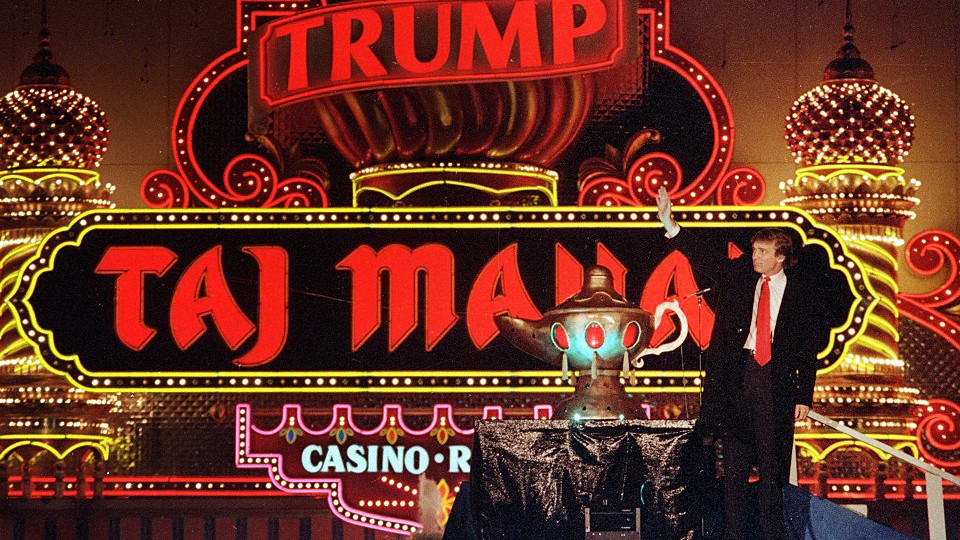
- In the belatedly 1980s, after insisting that his major qualification to build a new casino in Atlantic Metropolis was that he wouldn't need to utilize junk bonds, Trump used junk bonds to build Trump Taj Mahal. He built the casino but couldn't keep up with interest payments, so his visitor declared bankruptcy in 1991. He had to sell his yacht, his airline, and half his buying in the casino.
- A year later, some other of Trump's Atlantic City casinos, the Trump Plaza, went bust after losing more than than $550 1000000. Trump gave up his stake but otherwise insulated himself personally from losses, and managed to continue his CEO title, fifty-fifty though he surrendered whatever salary or role in mean solar day-to-solar day operations. Past the time all was said and done, he had some $900 million in personal debt.
- Trump bounced back over the following decade, simply past 2004, Trump Hotels and Casino Resorts was $1.8 billion in debt. The company filed for bankruptcy and emerged every bit Trump Entertainment Resorts. Trump himself was the chairman of the new company, but he no longer had a controlling pale in it.
- V years later, subsequently the real-estate collapse, Trump Entertainment Resorts once more went bankrupt. Trump resigned from the board, but the company retained his name. In 2014, he successfully sued to take his name off the company and its casinos—one of which had already closed, and the other of which was almost endmost.
The upshot: Trump is very touchy about whatsoever implication that he personally declared bankruptcy, arguing—merely equally he explains away his entrada contributions to Democrats—that he'due south just playing the game: "We'll have the company. We'll throw information technology into a chapter. We'll negotiate with the banks. We'll brand a fantastic deal. We'll use those. But they were never personal. This is nothing personal. Yous know, it'due south like on The Apprentice. It'southward not personal. Information technology'southward just business concern. Okay? If y'all expect at our greatest people, Carl Icahn with TWA then many others. Leon Black, Linens-n-Things and others. Henry Kravis. A lot of 'em, everybody. But with me information technology's 'Oh, y'all did—' this is a business concern matter. I've used the laws of this country to pare debt."
Read more: The Washington Post, William Cohan
The Undocumented Polish Workers
Where and when: New York City, 1980
The dirt: In order to construct his signature Trump Belfry, the builder first had to demolish the Bonwit Teller store, an architecturally beloved Art Deco edifice. The piece of work had to exist washed fast, and so managers hired 200 undocumented Polish workers to tear information technology down, paying them substandard wages for backbreaking work—$5 per 60 minutes, when they were paid at all. The workers didn't vesture hard hats and often slept at the site. When the workers complained about their back pay, they were allegedly threatened with deportation. Trump said he was unaware that illegal immigrants were working at the site.
The consequence: In 1991, a federal guess found Trump and other defendants guilty of conspiring to avert paying union alimony and welfare contributions for the workers. The decision was appealed, with partial victories for both sides, and ultimately settled privately in 1999. In a February GOP debate, Marco Rubio brought upwards the story to accuse Trump of hypocrisy in his stance on illegal clearing. Meanwhile, Massimo Calabresi shows that testimony under oath shows Trump was aware of illegal immigrants being employed there.
Read more: Michael Daly, The New York Times, Time
Alleged Marital Rape
Where and when: New York City, 1989
The dirt: While married to Ivana Trump, Donald Trump became angry at her—according to a book by Harry Hurt, over a painful scalp-reduction surgery—and allegedly forcibly had sex with her. Ivana Trump said during a deposition in their divorce case that she "felt violated" and that her hubby had raped her. Later, Ivana Trump released a statement proverb: "During a degradation given by me in connectedness with my betrothed instance, I stated that my husband had raped me. [O]n ane occasion during 1989, Mr. Trump and I had marital relations in which he behaved very differently toward me than he had during our union. As a adult female, I felt violated, equally the love and tenderness, which he ordinarily exhibited towards me, was absent. I referred to this as a 'rape,' just I do not want my words to be interpreted in a literal or criminal sense."
The upshot: When The Daily Beast reported on the incident, Trump'south right-paw man Michael Cohen threatened reporters and claimed—incorrectly—that a human being cannot legally rape his wife. The case is 1 of several cases where Trump has been accused of misogyny, including his comments about Megyn Kelly early on in the primary campaign or his fury at a lawyer who, during a degradation, asked for a break to pump breast milk. "You're disgusting," Trump said, and walked out. (Wayne Barrett collects some lowlights hither.)
Read more: The Daily Beast
Breaking Casino Rules
Where and when: New York and New Jersey, various
The dirt: Trump has been repeatedly fined for breaking rules related to his functioning of casinos. In 1990, with Trump Taj Mahal in trouble, Trump's begetter Fred strolled in and bought 700 chips worth a total of $3.5 1000000. The purchase helped the casino pay debt that was due, but because Fred Trump had no plans to take chances, the New Jersey gaming committee ruled that it was a loan that violated operating rules. Trump paid a $30,000 fine; in the end, the loan didn't prevent a bankruptcy the following yr. Every bit noted in a higher place, New Jersey also fined Trump $200,000 for arranging to go on blackness employees away from mafioso Robert LiButti's gambling table. In 1991, the Casino Control Commission fined Trump's company some other $450,000 for ownership LiButti nine luxury cars. And in 2000, Trump was fined $250,000 for breaking New York state law in lobbying to preclude an Indian casino from opening in the Catskills, for fear it would compete against his Atlantic City casinos.
The upshot: Trump admitted no wrongdoing in the New York case. He'south at present out of the casino concern.
Antitrust Violations
Where and when: New Jersey, 1986
The dirt: In 1986, Trump decided he wanted to expand his casino empire in Atlantic City. His plan was to mountain a hostile takeover of two casino companies, Holiday and Bally. Trump started buying up stock in the companies with an eye toward gaining control. But Bally realized what was going on and sued him for antitrust violations. "Trump hopes to wrest control of Bally from its public shareholders without paying them the command premium they otherwise could control had they been adequately informed of Trump'southward intentions," the company argued.
The event: Trump gave up the attempt in 1987, but the Federal Trade Commission fined him $750,000 for failing to disclose his purchases of stock in the 2 companies, which exceeded minimum disclosure levels.
Condo Hotel Shenanigans
Where and when: New York, Florida, Mexico, mid-2000s
The dirt: Trump was heavily involved in condo hotels, a pre-real-estate crash fixation in which people would purchase units that they'd merely use for a portion of the year. The remainder of the time, the units would be rented out equally hotel rooms, with the developer and the owner sharing the profit. For a variety of reasons, condo hotels turned out to exist a terrible thought. The event has been a slew of lawsuits past condo buyers who merits they were bilked. Fundamental to many of these is the question of what Trump's role in the projects was. In recent years, Trump has oftentimes substantially sold his name rights to developers—he gets a payoff, and they get the aura of luxury his name imparts. Merely in some of the condo-hotel suits, buyers complain that they bought the properties as investments considering of his imprimatur, merely to realize he was barely involved. (Similar complaints have been made nigh his involvement in a multilevel marketing scheme.)
The upshot: In the instance of Trump SoHo, in Manhattan, Trump's partners turned out to take a lengthy criminal past. Trump said he didn't know that, but—atypically—settled a lawsuit with buyers (while, typically, not admitting any wrongdoing). Some other, Trump International Hotel & Tower Fort Lauderdale, went into foreclosure, and Trump has sued the complex'south programmer. In 2013, he settled a accommodate with prospective buyers who lost millions when a development in Baja Mexico went under. Trump blamed the developers again, proverb he had only licensed his proper noun.
Read more than: Los Angeles Times, The New York Times, ibid., The Wall Street Periodical
Corey Lewandowski
Where and when: Jupiter, Florida, 2016
The dirt: Trump picked Corey Lewandowski to manage his campaign, despite a relatively short resume. For a long time, that seemed to work well for both—Trump soared to the lead in GOP polls. But Lewandowski hitting a rough patch in early March. As Breitbart reporter Michelle Fields tried to ask Trump a question later on a press conference, Lewandowski reached out and wrenched her out of the manner. Lewandowski and Trump insisted the incident had never happened and that Fields was "delusional," fifty-fifty though witnesses attested to having seen information technology.
The upshot: Surveillance footage caused by Jupiter Police from Trump National, site of the printing conference, clearly showed what had happened. Lewandowski was arrested for battery, but the prosecutor opted not to printing charges. Trump has said he may have been the one in danger, because Fields'due south pen could accept been a bomb.
Suing Journalist Tim O'Brien for Libel
Where and when: New York City, 2006–09
The dirt: In 2005, and so-New York Times reporter Tim O'Brien published the book TrumpNation, in which he reported that Trump was really simply worth $150–250 one thousand thousand, not the billions he claimed. Trump, incensed, sued O'Brien for $v billion. (That's one way to get a billionaire.)
The upshot: Trump's suit against O'Brien was tossed. More recently, O'Brien has mocked Trump's current claims about his net worth. Trump, meanwhile, has said on the campaign trail—and, mindblowingly, in an interview with the Washington Post editorial board—that he wants to make it easier to sue for libel. The Postal service combed through Trump'southward deposition in the instance and found 30 instances where Trump admitted to having lied.
Read more than: O'Brien'southward original report, O'Brien in 2015, William Cohan, The Washington Mail
Refusing to Pay Workers and Contractors
Where and when: various, 1980s–nowadays
The clay: Contractors, waiters, dishwashers, and plumbers who accept worked at Trump projects say that his company stiffed them for work, refusing to pay for services rendered. USA Today did a lengthy review, finding that some of those contracts were for hundreds of thousands of dollars, many owed to small businesses that failed or struggled to continue because of unpaid bills. (Trump was also establish to accept improperly withheld compensation in the undocumented Smoothen worker controversy.)
The outcome: Trump has offered various excuses, including shoddy workmanship, but the scale of the trouble—hundreds of allegations—makes that hard to credit. In some cases, fifty-fifty the lawyers Trump has hired to defend him have sued him for declining to pony up their fees. In one lawsuit, a Trump employee admitted in court that a painter was stiffed because managers determined they had "already paid plenty." The cases are damaging because they prove Trump not driving a hard deal with other businesses, but harming ordinary, hard-working Americans. More than recently, several contractors filed $5 one thousand thousand in liens against Trump's new hotel in Washington, alleging he has not paid them for services rendered.
Read more than: USA Today, The Wall Street Journal, The Washington Postal service
Trump Found
Where and when: Boca Raton and elsewhere, 2005–?
The dirt: Around the aforementioned time Donald Trump was operating Trump Academy, the allegedly fraudulent real-estate seminar for which he'due south now being sued, he as well franchised his name to Irene and Mike Milin, serial operators of become-rich-quick schemes. Unlike Trump U., Trump did not own the company. Instead, he licensed his name, actualization in an informercial and promising falsely that he would manus-pick instructors. (He made a like promise with Trump U.) As Jonathan Martin reports, the course materials at Trump Institute consisted in function of textbooks that were plagiarized.
The upshot: The Milins were forced to declare bankruptcy in 2008, in part because of the law-enforcement investigations and lawsuits against their company. Trump Establish continued on for a few years afterward. A Trump aide says he was unaware of the plagiarism, simply said he stood by the curriculum.
Read more: The New York Times, Ars Technica, The Daily Beast
Buying Upwardly His Own Books
Where and when: various, 2016
The dirt: The Daily Fauna noticed in FEC filings that the Trump campaign spent more than than $55,000 ownership his own volume Crippled America: How to Make America Great Once more. (The book has since been retitled Great Again: How to Set up Our Crippled America for the paperback edition.) That ways Trump used donor coin to his campaign to buy a volume, sending the cash back to himself. Copies were given to delegates at the Republican National Convention.
The event: The maneuver could pause FEC rules, campaign expert Paul S. Ryan told the Animate being: "It'south fine for a candidate's book to be purchased by his commission, but information technology's impermissible to receive royalties from the publisher ... There's a well established precedent from the FEC that funds from the entrada business relationship tin can't end up in your ain pocket." The Huffington Mail also noticed that Trump jacked up rent for campaign offices when he stopped funding his own campaign.
Read more: The Daily Beast
Undocumented Models
Where and when: New York, 1999–?
The dirt: One-time models who worked for Trump Model Direction say that they and others worked for the bureau in the U.s. despite non having proper permits. Some of them worked on tourist visas, either never getting the correct permits or else getting them simply after working in the U.Due south. illegally for months.
The event: The story is embarrassing for Trump, who has argued that U.S. immigration laws should be much more than strictly enforced. Some models also received H-1B visas, a special type of permit for workers in specialized industries—a program that Trump has criticized on the campaign trail this yr.
Read more: Female parent Jones
The Trump Foundation
Where and when: Various, 1988–present
The clay: Though Donald Trump oftentimes promises to requite to charity, his foundation has proven rather skimpy on the gifts over the years—and when it has given, the money has oftentimes come up from pockets other than Trump's, including outside donors and even NBC. In the mid-2000s, Trump reconfigured the clemency as a pass-through, soliciting donations from others and and so giving the money away as though from himself. It appears that the foundation did not have the requisite legal permission from New York State to gather donations. In a few cases, the foundation likewise reported making donations it had not made. There's special scrutiny on one $25,000 donation information technology did give, to a group supporting Florida Attorney Full general Pam Bondi, which arrived but days before she quashed an investigation into Trump University and the Trump Institute. Trump also appears to have used $258,000 in foundation coin, about of information technology given past other donors and not himself, to settle legal disputes, including donations to clemency in lieu of paying fines. Trump directed more than $2 million in income to the foundation, and if he didn't pay taxes on them—his campaign for the most part refused to say—information technology would be illegal tax-dodging.
The upshot: The foundation appears to have broken IRS rules on "self-dealing" by paying to resolve the legal disputes every bit well equally buying a portrait of Trump and a Tim Tebow helmet that went back to the Trump family. In November, in tax filings posted online, the Trump Foundation said information technology had violated self-dealing rules in 2015 and in previous, indeterminate, years. On the donation, Trump and Bondi both say there was no quid-pro-quo, just the donation was an illegal one for a charitable nonprofit, and the foundation had to pay a $two,500 fine. Liberal watchdog group Citizens for Responsibility and Ethics in Washington charges other laws may have been cleaved also. New York Chaser General Eric Schneiderman has reportedly launched an investigation into the foundation. Schneiderman has also informed the foundation that it is in violation of rules on fundraising and ordered information technology to quit. Trump has announced plans to shut his foundation, but reportedly cannot practise so while it is under investigation.
Read more than: David Fahrenthold (several times over), me, The New York Times, Fahrenthold, Fahrenthold, Fahrenthold, Fahrenthold, Fahrenthold, Fahrenthold
The Cuban Embargo
Where and when: Cuba, 1998–present
The dirt: Although U.Southward. law prohibits American commercial involvement in Republic of cuba, in that location'southward testify to suggest that the Trump Organization has been active on the island for well-nigh 2 decades. In 1998, every bit the Clinton administration loosened some restrictions, Trump scouted business opportunities, and according to documents viewed by Newsweek, spent $68,000 there, likely in violation of the police. More than recently, Trump executives have traveled to Cuba in credible scouting trips for golf resorts, BusinessWeek reports.
The upshot: Trump and his company accept not commented in any detail on either report. One Trump executive told BusinessWeek that his travel to Cuba was unrelated to the company, while some other associate said he'd discussed forming a visitor with Trump to run golf courses in Republic of cuba. Experts said these activities would all likely fall afoul of current rules.
Read more: BusinessWeek, Newsweek
dickinsonanyby1955.blogspot.com
Source: https://www.theatlantic.com/politics/archive/2017/01/donald-trump-scandals/474726/
0 Response to "Families That Won Lawsuits Against Donald J. Trump for Sexual Misconduct"
Post a Comment