Tap Water in Syracuse, Can I Drink It
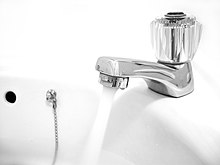
A simple indoor h2o tap
Tap water (also known as faucet water, running water, or municipal water) is water supplied through a tap, a water dispenser valve. Tap water is usually used for drinking, cooking, washing, and toilet flushing. Indoor tap h2o is distributed through "indoor plumbing", which has existed since antiquity but was available to very few people until the second half of the 19th century when it began to spread in popularity in what are at present developed countries. Tap water became common in many regions during the 20th century, and is now defective mainly among people in poverty, especially in developing countries.
In many countries, tap h2o is frequently associated with drinking h2o. Governmental agencies commonly regulate tap h2o quality. Household h2o purification methods such as water filters, boiling, or distillation tin be used to care for tap h2o's microbial contagion to improve its potability.[1] The awarding of technologies (such as water treatment plants) involved in providing clean water to homes, businesses, and public buildings is a major subfield of germ-free engineering science. Calling a h2o supply "tap water" distinguishes it from the other main types of fresh water which may exist available; these include water from rainwater-collecting cisterns, water from hamlet pumps or town pumps, h2o from wells, or water carried from streams, rivers, or lakes (whose potability may vary).
Background [edit]
Providing tap h2o to big urban or suburban populations requires a complex and carefully designed arrangement of collection, storage, handling and distribution, and is commonly the responsibility of a government bureau.
Publicly available treated water has historically been associated with major increases in life expectancy and improved public health. Water disinfection tin can greatly reduce the risks of waterborne diseases such as typhoid and cholera. There is a great need effectually the globe to disinfect drinking water. Chlorination is currently the near widely used water disinfection method, although chlorine compounds can react with substances in water and produce disinfection past-products (DBP) that pose problems to human health.[2] Local geological conditions affecting groundwater are determining factors for the presence of various metallic ions, often rendering the water "soft" or "hard".
Tap h2o remains susceptible to biological or chemical contamination. Water contagion remains a serious wellness outcome around the globe, and diseases resulted from consuming contaminated water cause the decease of 1.6 million children each twelvemonth.[3] In the consequence of contamination deemed dangerous to public health, regime officials typically effect an advisory regarding water consumption. In the case of biological contagion, residents are unremarkably advised to boil their h2o before consumption or to utilize bottled water as an culling. In the example of chemical contagion, residents may be advised to refrain from consuming tap water entirely until the matter is resolved.
In many areas, low concentration of fluoride (< 1.0 ppm F) is intentionally added to tap water to amend dental health, although in some communities "fluoridation" remains a controversial upshot. (See water fluoridation controversy). Nevertheless, long-term consumption of water with high fluoride concentration (> ane.5 ppm F) can have serious undesirable consequences such equally dental fluorosis, enamel mottle and skeletal fluorosis, os deformities in children. Fluorosis severity depends on how much fluoride is present in the water, every bit well equally people's nutrition and physical activity. Defluoridation methods include membrane-based methods, atmospheric precipitation, absorption, and electrocoagulation.[three]
Regulation and compliance [edit]
Usa [edit]
The Usa Environmental Protection Agency (EPA) regulates the allowable levels of some contaminants in public water systems.[4] There may also be numerous contaminants in tap h2o that are not regulated by EPA and yet potentially harmful to homo health. Community water systems—those systems that serve the aforementioned people throughout the year—must provide an almanac "Consumer Confidence Written report" to customers. The written report identifies contaminants, if whatsoever, in the water organization and explains the potential health impacts.[5] After the Flint lead crisis (2014), researchers take paid special attention in studying quality trends in drinking h2o all across the U.s.. Unsafe level of lead were found in tap water in unlike cities, such as Sebring, Ohio in August 2015, and Washington, DC, in 2001.[three] Several studies show that a Safe Drinking Water Act (SDWA) health violation occurs in effectually seven-viii% of community water system (CWS) in an average year.[six] Around 16 1000000 cases of acute gastroenteritis occur each twelvemonth in the United states of america, due to the existence of contaminants in drinking h2o.[seven]
Before a water supply system is synthetic or modified, the designer and contractor are required to consult the local plumbing lawmaking and obtain a building allow prior to construction.[8] [9] Replacing an existing water heater may crave a allow and inspection of the work. The U.s.a. national standard for potable water piping guidelines is NSF/ANSI 61 certified materials. NSF/ANSI as well sets standards for certifying polytanks, though the Food and Drug Administration (FDA) approves the materials.[ relevant? ]
Nihon [edit]
To improve water quality, Japan'southward Ministry building of Wellness revised its water quality standards, which were implemented in April 2004.[ten] Numerous professionals developed the drinking h2o standards. [10] They also adamant ways to manage the high quality h2o system. In 2008, improved regulations were conducted to improve the water quality and reduce the risk of water contagion. [10]
Fixtures and appliances [edit]
Everything in a edifice that uses water falls under one of two categories; fixture or appliance. As the consumption points higher up perform their function, virtually produce waste/sewage components that will require removal by the waste matter/sewage side of the organisation. The minimum is an air gap. See cross connection control & backflow prevention for an overview of backflow prevention methods and devices currently in utilise, both through the utilize of mechanical and physical principles.
Fixtures are devices that use water without an additional source of power.
Fittings and valves [edit]
Beverage water supply systems are composed of pipes, fittings and valves.
Materials [edit]
The installation of h2o pipes can be done using the following plastic[11] and metal[11] materials:
Plastic [edit]
- polybutylene (Atomic number 82)
- high density cantankerous-linked polyethylene (PE-X)
- block copolymer of polypropylene (PP-B)
- the polypropylene copolymer (PP-H)
- random copolymer of polypropylene (random) (PP-R)
- Layer: cross-linked polyethylene, aluminum, high-density polyethylene (PE-X / Al / PE-Hard disk)
- Layer: polyethylene crosslinked, aluminum, cross-linked polyethylene (PE-Ten / Al / PE-10)
- Layer copolymer of a random polypropylene, aluminum, polypropylene random copolymer (PP-R / Al / PP-R)
- polyvinyl chloride, chlorinated (PVC-C)
- polyvinyl chloride - not softened(but common cold water) (PVC-U)
Metals [edit]
- carbon steel, ordinary galvanized
- corrosion resistant steel
- Deoxidized High Phosphorus copper(Cu-DHP)
- lead (no longer used for new installations due to its toxicity)
Other materials, if the pipes fabricated from them have been let into circulation and the widespread utilize in the construction of the water supply systems.
Lead pipes [edit]
For many centuries, water pipes were made of atomic number 82, considering of its ease of processing and immovability. The use of pb pipes was a cause of wellness bug due to ignorance of the dangers of pb on the man body, which causes miscarriages and loftier death rates of newborns. Lead pipes, which were installed by and large in the late 1800s in the US, are yet common today, much of which are located in the Northeast and the Midwest.[12] Their impact is relatively small due to the fouling of pipes and rock cessation of the evolution of lead in the water; yet, atomic number 82 pipes are still detrimental. Virtually of the atomic number 82 pipes that be today are being removed and replaced with the more common cloth, copper or some type of plastic.
Remnants of pipes in some languages are the names of the experts involved in the execution, reparation, maintenance, and installation of h2o supply systems, which have been formed from the Latin word 'lead', English language word 'plumber', French word, 'plombier'.
Beverage h2o supply [edit]
Potable h2o is water that is drinkable and does not pose a risk to health.[thirteen] This supply may come from several possible sources.
- Municipal water supply
- Water wells
- Processed h2o from creeks, streams, rivers, lakes, rainwater, etc.
Domestic water systems have been evolving since people starting time located their homes near a running h2o supply, such every bit a stream or river. The h2o menses too allowed sending wastewater away from the residences.
Modern plumbing delivers clean, safety, and potable water to each service point in water distribution system, including taps.[14] It is of import that the make clean h2o non be contaminated past the wastewater (disposal) side of the process system. Historically, this contamination of drinking water has been one of the largest killers of humans.[15]
Nigh of the mandates for enforcing drinking water quality standards are not for the distribution system, but for the treatment plant. Even though the water distribution system is supposed to evangelize the treated water to the consumers' taps without water quality deposition, complicated concrete, chemical, and biological factors within the organisation can crusade contamination of tap water.[fourteen]
At that place is a huge gap regarding the drink water supply between the adult and developing world. In general, Africa, especially Sub-Saharan Africa, has the poorest water supply organisation in the world considering of the insufficient admission to the arrangement and the low quality of the h2o in the region.[13]
Tap water can sometimes appear cloudy and is oft mistaken for mineral impurities in the h2o. Information technology is usually acquired past air bubbles coming out of solution due to change in temperature or pressure level. Because cold h2o holds more air than warm h2o, small bubbling will appear in water. It has a high dissolved gas content that is heated or depressurized, which reduces how much dissolved gas the water can agree. The harmless cloudiness of the water disappears quickly every bit the gas is released from the water.[16]
Hot water supply [edit]
Domestic hot h2o is provided by means of water heater appliances, or through district heating. The hot water from these units is then piped to the diverse fixtures and appliances that require hot water, such equally lavatories, sinks, bathtubs, showers, washing machines, and dishwashers.
Water menstruation reduction [edit]
Water menstruation through a tap tin be reduced by inexpensive small plastic flow reducers. These restrict catamenia between 15 and 50%, aiding water conservation and reducing the burden on both h2o supply and treatment facilities.
Wastewater [edit]
Wastewater from various appliances, fixtures, and taps is transferred to the waste product and sewage removal organization via the sewage drain organization to treatment plants. This organization consists of larger diameter pipe, h2o traps, and ventilation to forestall toxic gases from entering the living space.
Comparing to bottled water [edit]
United States [edit]
Contaminant levels found in tap water vary between households and plumbing systems. While the majority of US households have access to high-quality tap water, demand for bottled h2o increases.[17] In 2002, the Gallup Public Opinion Poll revealed that the possible health risk associated with tap h2o consumption is i of the master reasons that cause American consumers to adopt bottled water over tap water.[18]
The trust level towards tap water depends on various criteria, including the existing governmental regulations towards the water quality and their appliance. In 1993, the cryptosporidium outbreak in Milwaukee, Wisconsin, led to a massive hospitalization of more than 400,000 residents and was considered the largest in US history.[19] Severe violations of tap water standards influence the decrease in public trust.[xx]
The difference in h2o quality betwixt bottled and tap water is debatable. In 1999, the Natural Resources Defence Council (NRDC) released controversial findings from a iv-twelvemonth report on bottled h2o. The study claimed that one-tertiary of the tested waters were contaminated with synthetic organic chemicals, leaner, and arsenic. At to the lowest degree one sample exceeded country guidelines for contagion levels in bottled water.[21]
In the Usa, some municipalities make an effort to employ tap water over bottled water on governmental backdrop and events. Voters in Washington State repealed a bottled h2o tax via citizen initiative.[ citation needed ]
See besides [edit]
- Automatic balancing valves
- Bottled h2o – Water sold every bit a bottled product
- Drought – Extended period of deficiency in a region's water supply
- Fountain – Architecture which pours water into a basin or jets it into the air
- Irrigation – Artificial application of water to country
- Pipe support – Mounting element that transfers loads from a pipe to supporting structures
- Plumbing – Systems for conveying fluids
- Rainwater – Precipitation in the grade of water aerosol
- Victaulic – Programmer and producer of mechanical pipage joining systems
- Water fluoridation – Addition of fluoride to a water supply to reduce tooth disuse
- Water supply – Provision of water past public utilities, commercial organisations or others
- Water pipe
- H2o cycle – Continuous motility of water on, above and beneath the surface of the Earth
- Walkerton Tragedy
References [edit]
- ^ Ahuja, Satinder (2018). Advances in H2o Purification Techniques : Meeting the Needs of Adult and Developing Countries. San Diego: Elsevier. ISBN978-0-12-814791-seven. OCLC 1078565849.
- ^ Water disinfection. Kelly M. Buchanan. Hauppauge, N.Y.: Nova Science Publishers. 2010. ISBN978-1-61122-401-6. OCLC 730450380.
{{cite book}}: CS1 maint: others (link) - ^ a b c Ahuja, Satinder (2018). Advances in Water Purification Techniques: Meeting the Needs of Developed and Developing Countries. San Diego: Elsevier. ISBN978-0-12-814791-7. OCLC 1078565849.
- ^ "National Primary Drinking H2o Regulations". Washington, D.C.: United states Ecology Protection Agency (EPA). 2019-09-17.
- ^ "CCR Information for Consumers". Consumer Confidence Reports. EPA. 2019-09-27.
- ^ Messner, Michael; Shaw, Susan; Regli, Stig; Rotert, Ken; Blank, Valerie; Soller, Jeff (2006). "An arroyo for developing a national estimate of waterborne disease due to drinking water and a national estimate model application". Periodical of Water and Wellness. 4 Suppl 2: 201–240. doi:10.2166/wh.2006.024. ISSN 1477-8920. PMID 16895092.
- ^ Allaire, Maura; Wu, Haowei; Lall, Upmanu (2018-02-27). "National trends in drinking water quality violations". Proceedings of the National Academy of Sciences. 115 (9): 2078–2083. doi:10.1073/pnas.1719805115. ISSN 0027-8424. PMC5834717. PMID 29440421.
- ^ Uniform Plumbing Lawmaking, IAPMO
- ^ International Plumbing Code, ICC
- ^ a b c "Ministry of Health, Labour and Welfare: Water Supply in Japan". www.mhlw.go.jp . Retrieved 2021-xi-18 .
- ^ a b "Takagi T-KJr2-IN-NG Indoor". tanklesses.com. 2020.
- ^ 1963-, Troesken, Werner (2006). The not bad lead water pipe disaster. MIT Press. ISBN0-262-20167-4. OCLC 70176961.
{{cite book}}: CS1 maint: numeric names: authors listing (link) - ^ a b writer., Yigezu, Israel (February 2014). The challenges and prospects of potable water management at edja woreda-ethiopi. ISBN978-3-95489-610-3. OCLC 878149046.
- ^ a b Board., National Inquiry Council (U.Southward.). Committee on Public Water Supply Distribution Systems: Assessing and Reducing Risks. National Research Quango (U.S.). Water Science and Engineering (2006). Drinking h2o distribution systems : assessing and reducing risks. National Academies Press. ISBN0-309-10306-1. OCLC 71294470.
- ^ Plumbing: the Arteries of Civilization, Modern Marvels video series, The History Chfifr5tyk A&Eastward Telly, 1996
- ^ Massachusetts Water Resource Authority. http://www.mwra.com/04water/2004/whitewater.htm
- ^ Doria, Miguel F. (2006-06-01). "Bottled water versus tap h2o: agreement consumers' preferences". Journal of Water and Health. 4 (2): 271–276. doi:10.2166/wh.2006.0023. ISSN 1477-8920. PMID 16813019.
- ^ Saylor, Amber; Prokopy, Linda Stalker; Amberg, Shannon (September 2011). "What'due south Wrong with the Tap? Examining Perceptions of Tap Water and Bottled Water at Purdue University". Environmental Management. 48 (3): 588–601. Bibcode:2011EnMan..48..588S. doi:10.1007/s00267-011-9692-vi. ISSN 0364-152X. PMID 21643837. S2CID 22067616.
- ^ Mac Kenzie, William R.; Hoxie, Neil J.; Proctor, Mary Eastward.; Gradus, K. Stephen; Blair, Kathleen A.; Peterson, Dan Eastward.; Kazmierczak, James J.; Addiss, David G.; Fox, Kim R.; Rose, Joan B.; Davis, Jeffrey P. (1994-07-21). "A Massive Outbreak in Milwaukee of Cryptosporidium Infection Transmitted through the Public Water Supply". New England Journal of Medicine. 331 (3): 161–167. doi:ten.1056/NEJM199407213310304. ISSN 0028-4793. PMID 7818640.
- ^ Pierce, Gregory; Gonzalez, Silvia (2017-02-01). "Mistrust at the tap? Factors contributing to public drinking h2o (mis)perception across The states households". Water Policy. 19 (one): 1–12. doi:10.2166/wp.2016.143. ISSN 1366-7017.
- ^ January 05; 2016; Postman, rew. "The Truth About Tap". NRDC . Retrieved 2021-04-24 .
{{cite web}}: CS1 maint: numeric names: authors list (link)
- ASTM B75-02 Specification for Seamless Copper Tube
- ASTM B42-02e1 Standard Specification for Seamless Copper Pipe, Standard Sizes
- ASTM B88-03 Standard Specification for Seamless Copper Water Tube
- AWWA Research Foundation, Residential Cease Uses of Water, ISBN 1-58321-016-four, 1999
External links [edit]
- The H2o Information Middle - An online resource for public water system nuts and water direction issues from the National Academy of Sciences.
- Us Environmental Protection Agency Drinking water page
- U.s.a.. Centers for Affliction Control and Prevention (CDC) Healthy Water - Public Water Systems - 1-stop resource for information on public water systems supplying tap water including data on drinking h2o, fluoridation, h2o testing, water-related diseases and contaminants, etc., plus links to EPA, WHO, and other resources.
- the International Code Quango
- the American Society for Testing and Materials
- the National Ground Water Clan
- The Copper Evolution Clan
- 2008 Municipal Water Pricing Study(Canada)
- Notes on Pipage—Copper Pipage weights and max PSI
dickinsonanyby1955.blogspot.com
Source: https://en.wikipedia.org/wiki/Tap_water
0 Response to "Tap Water in Syracuse, Can I Drink It"
Post a Comment